天池新人赛-零基础入门数据挖掘 - 二手车交易价格预测-排名374
赛题介绍:赛题以预测二手车的交易价格为任务,数据集报名后可见并可下载,该数据来自某交易平台的二手车交易记录,总数据量超过40w,包含31列变量信息,其中15列为匿名变量。为了保证比赛的公平性,将会从中抽取15万条作为训练集,5万条作为测试集A,5万条作为测试集B,同时会对name、model、brand和regionCode等信息进行脱敏。具体介绍:二手车交易价格预测具体思路:用中位数填充空值修改
·
赛题介绍:
赛题以预测二手车的交易价格为任务,数据集报名后可见并可下载,该数据来自某交易平台的二手车交易记录,总数据量超过40w,包含31列变量信息,其中15列为匿名变量。为了保证比赛的公平性,将会从中抽取15万条作为训练集,5万条作为测试集A,5万条作为测试集B,同时会对name、model、brand和regionCode等信息进行脱敏。
具体介绍:二手车交易价格预测
具体思路:
用中位数填充空值
修改异常数据
特征归一化
切分数据集
使用神经网络和极端回归树做Stacking
提交记录: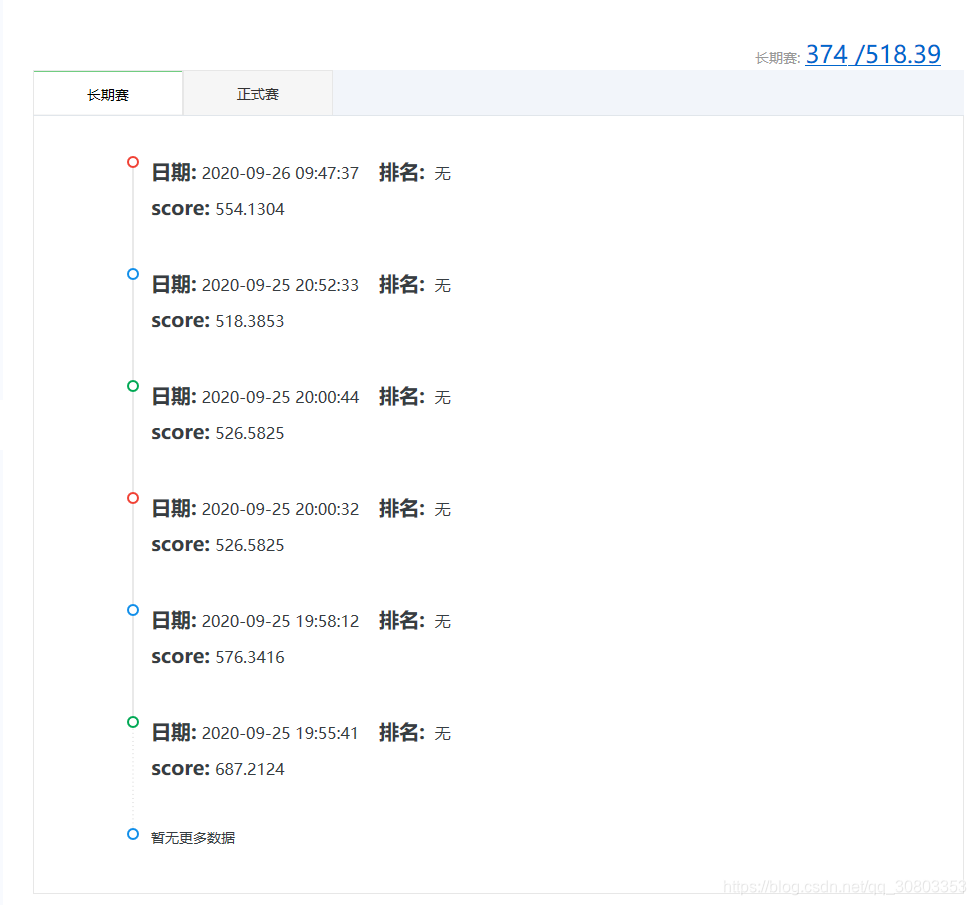
主要运行代码如下:
import os

import numpy as np
import pandas as pd
from sklearn.model_selection import train_test_split
from sklearn.preprocessing import MinMaxScaler
from tensorflow import keras

from Aero_engine_life.data_model import build_model_etr

os.chdir(r'E:\项目文件\二手车交易价格\\')
from sklearn.metrics import mean_absolute_error

data_train = pd.read_csv(r'used_car_train_20200313.csv', sep=' ')
data_test = pd.read_csv(r'used_car_testB_20200421.csv', sep=' ')
data_train.replace(to_replace='-', value=np.nan, inplace=True)
data_test.replace(to_replace='-', value=np.nan, inplace=True)
# 用中位数填充空值
data_train.fillna(data_train.median(), inplace=True)
data_test.fillna(data_train.median(), inplace=True)
tags = ['model', 'brand', 'bodyType', 'fuelType', 'regionCode', 'regionCode', 'regDate', 'creatDate', 'kilometer',
        'notRepairedDamage', 'power', 'v_0', 'v_1', 'v_2', 'v_3', 'v_4', 'v_5', 'v_6',
        'v_7', 'v_8', 'v_9', 'v_10', 'v_11', 'v_12', 'v_13', 'v_14']
# 修改异常数据
data_train['power'][data_train['power'] > 600] = 600
data_test['power'][data_test['power'] > 600] = 600
# 特征归一化
min_max_scaler = MinMaxScaler()
min_max_scaler.fit(data_train[tags].values)
x = min_max_scaler.transform(data_train[tags].values)
x_ = min_max_scaler.transform(data_test[tags].values)
# 获得y值
y = data_train['price'].values
# 切分数据集
x_train, x_test, y_train, y_test = train_test_split(x, y, test_size=0.2)
model = keras.Sequential([
    keras.layers.Dense(250, activation='relu', input_shape=[26]),
    keras.layers.Dense(250, activation='relu'),
    keras.layers.Dense(250, activation='relu'),
    keras.layers.Dense(1)])
model.compile(loss='mean_absolute_error',
              optimizer='adam')
model.fit(x_train, y_train, batch_size=2048, epochs=111)
# 比较训练集和测试集效果
x_predict = model.predict(x_train)
test_pred = model.predict(x_test)

# model_lgb = build_model_lgb(x_train, y_train)
# val_lgb = model_lgb.predict(x_test)
model_etr = build_model_etr(x_train, y_train)
val_etr = model_etr.predict(x_test)
# model_rf = build_model_rf(x_train, y_train)
# val_rf = model_rf.predict(x_test)
# Starking 第一层
print(mean_absolute_error(y_train, x_predict))
print(mean_absolute_error(y_test, test_pred))
train_etr_pred = model_etr.predict(x_train)
print('etr训练集,mae:', mean_absolute_error(y_train, train_etr_pred))
# train_lgb_pred = model_lgb.predict(x_train)
# print('lgb训练集,mae:', mean_absolute_error(y_train, train_lgb_pred))
# write_mae('lgb', '训练集', mean_absolute_error(y_train, train_lgb_pred))
# train_rf_pred = model_rf.predict(x_train)
# print('rf训练集,mae:', mean_absolute_error(y_train, train_rf_pred))
# write_mae('rf', '训练集', mean_absolute_error(y_train, train_rf_pred))

Strak_X_train = pd.DataFrame()
# Strak_X_train['Method_1'] = train_rf_pred
# Strak_X_train['Method_2'] = train_lgb_pred
Strak_X_train['Method_3'] = train_etr_pred
Strak_X_train['Method_4'] = x_predict

Strak_X_val = pd.DataFrame()
# Strak_X_val['Method_1'] = val_rf
# Strak_X_val['Method_2'] = val_lgb
Strak_X_val['Method_3'] = val_etr
Strak_X_val['Method_4'] = test_pred

# 第二层
model_Stacking = build_model_etr(Strak_X_train, y_train)

val_pre_Stacking = model_Stacking.predict(Strak_X_val)


test_pred1 = model.predict(x_)
subA_etr = model_etr.predict(x_)
# subA_lgb = model_lgb.predict(x_)
# subA_rf = model_rf.predict(x_)
Strak_X_test = pd.DataFrame()
# Strak_X_test['Method_1'] = subA_rf
# Strak_X_test['Method_2'] = subA_lgb
Strak_X_test['Method_3'] = subA_etr
Strak_X_test['Method_4'] = test_pred1

pred = model_Stacking.predict(Strak_X_test)
print(test_pred1)
np.savetxt('submit_s.csv', test_pred1)
模型代码如下:
import os

from sklearn.metrics import mean_absolute_error, mean_squared_error
from lightgbm import LGBMRegressor
from sklearn.ensemble import RandomForestRegressor, ExtraTreesRegressor
from sklearn.model_selection import GridSearchCV

from utils.read_write import writeOneCsv, pdReadCsv


def get_train():
    file = 'train_label.csv'
    # file = 'download_label.csv'
    # file = 'test_label.csv'
    train = pdReadCsv(file, ',')
    return train.values[:, 3:-1], train.values[:, -1:].ravel()


def build_model_rf(x_train, y_train):
    estimator = RandomForestRegressor(criterion='mse')
    param_grid = {
        'max_depth': range(33, 35, 9),
        'n_estimators': range(73, 77, 9),
    }
    model = GridSearchCV(estimator, param_grid, cv=3)
    model.fit(x_train, y_train)
    print('rf')
    print(model.best_params_)
    writeParams('rf', model.best_params_)
    return model


def build_model_etr(x_train, y_train):
    # 极端随机森林回归   n_estimators 即ExtraTreesRegressor最大的决策树个数
    estimator = ExtraTreesRegressor(criterion='mse')
    param_grid = {
        'max_depth': range(33, 39, 9),
        'n_estimators': range(96, 99, 9),
    }
    model = GridSearchCV(estimator, param_grid)
    model.fit(x_train, y_train)
    print('etr')
    print(model.best_params_)
    writeParams('etr', model.best_params_)
    return model


def build_model_lgb(x_train, y_train):
    estimator = LGBMRegressor()
    param_grid = {
        'learning_rate': [0.1],
        'n_estimators': range(77, 78, 9),
        'num_leaves': range(59, 66, 9)
    }
    gbm = GridSearchCV(estimator, param_grid)
    gbm.fit(x_train, y_train.ravel())
    print('lgb')
    print(gbm.best_params_)
    writeParams('lgb', gbm.best_params_)
    return gbm


def scatter_line(y_val, y_pre):
    import matplotlib.pyplot as plt
    xx = range(0, len(y_val))
    plt.scatter(xx, y_val, color="red", label="Sample Point", linewidth=3)
    plt.plot(xx, y_pre, color="orange", label="Fitting Line", linewidth=2)
    plt.legend()
    plt.show()


def score_model(train, test, predict, model, data_type):
    score = model.score(train, test)
    print(data_type + ",R^2,", round(score, 6))
    writeOneCsv(['staking', data_type, 'R^2', round(score, 6)], src + '调参记录.csv')
    mae = mean_absolute_error(test, predict)
    print(data_type + ',MAE,', mae)
    writeOneCsv(['staking', data_type, 'MAE', mae], src + '调参记录.csv')
    mse = mean_squared_error(test, predict)
    print(data_type + ",MSE,", mse)
    writeOneCsv(['staking', data_type, 'MSE', mse], src + '调参记录.csv')


def writeParams(model, best):
    if model == 'lgb':
        writeOneCsv([model, best['num_leaves'], best['n_estimators'], best['learning_rate']], src + '调参记录.csv')
    else:
        writeOneCsv([model, best['max_depth'], best['n_estimators'], 0], src + '调参记录.csv')


def write_mse(model, data_type, mse):
    writeOneCsv([model, data_type, 'mse', mse], src + '调参记录.csv')
读写文件read_write.py的方法:
# -*- coding: utf-8   二层循环版本、比较慢
import csv
import json
import os
from urllib import request
import numpy as np
import pandas as pd
from tqdm import tqdm


#   写CSV文件,写一行就换行,追加方式
def writeCsv(relate_record, src):
    with open(src, 'w', newline='\n') as csvFile:
        writer = csv.writer(csvFile)
        for row in relate_record:
            try:
                writer.writerow(row)
            except Exception as e:
                print(e)
                print(row)
                # writeCsvUTF8(relate_record,bus)


# def writeExcept(row,bus):
#     with open(filePath, 'r', encoding='utf-8') as dic:
#         ##    dic.read()
#         for item in dic:
#             if item.encode('utf-8').decode('utf-8-sig').strip() == s:
#                 print('ok')
#             print(item)
#     print(s)


#   写CSV文件,写一行就换行,追加方式
def writeOneCsv(relate_record, src):
    try:
        with open(src, 'a', newline='\n') as csvFile:
            writer = csv.writer(csvFile)
            writer.writerow(relate_record)
        # csvFile.close()
    except Exception as e:
        print(e)
        print(relate_record)
        # writeCsvGBK(relate_record,bus)


#   写CSV文件,写一行就换行,追加方式
def writeCsvUTF8(relate_record, src):
    try:
        with open(src, 'a', newline='\n', encoding='utf-8') as csvFile:
            writer = csv.writer(csvFile)
            writer.writerow(relate_record)
    except:
        print(relate_record)


#   写CSV文件,写一行就换行,追加方式
def writeCsvGbk(relate_record, src):
    try:
        with open(src, 'a', newline='\n', encoding='gbk') as csvFile:
            writer = csv.writer(csvFile)
            writer.writerow(relate_record)
    except:
        print(relate_record)


#   写Txt文件,写一行就换行,追加方式
def writeTxt(relate_record, src):
    with open(src, 'w', newline='\n') as file:
        for i in relate_record:
            for cell in i:
                file.write(cell)
                file.write(',')
            file.write('\n')
        file.close()


#   写Txt文件,写一行就换行,追加方式
def writeOneTxt(one_record, src):
    try:
        with open(src, 'a') as file:
            file.write(one_record)
            file.write('\n')
    except Exception as e:
        print(e)


#   写Json文件,写一行就换行,追加方式
def writeJson(relate_record, src):
    Json_str = json.dumps(relate_record, ensure_ascii=False)
    with open(src, 'a') as Json_file:
        Json_file.write(Json_str)
    Json_file.close()


#   写Json文件,一个数据一个文件
def writeOneJson(relate_record, src):
    Json_str = json.dumps(relate_record, ensure_ascii=False)
    with open(src, 'w', encoding='utf-8') as Json_file:
        Json_file.write(Json_str)
    Json_file.close()


def readJsonToCsv(dict, src):
    df = pd.DataFrame.from_dict(dict, orient='index')
    df.transpose()
    df.to_csv(src)

def savPng(url,filename):
    try:
        rsp = request.urlopen(url)
        img = rsp.read()
        with open(filename, 'wb') as f:
            f.write(img)
    except Exception as e:
        print(url)
        print(e)


def readJson(filepath):
    try:
        with open(filepath, 'r', encoding='GBK') as file_open:
            data = json.load(file_open)
        file_open.close()
        return data
    except:
        try:
            with open(filepath, 'r', encoding='utf-8') as file_open:
                data = json.load(file_open)
                file_open.close()
                return data
        except:
            with open(filepath, 'r', encoding = "unicode_escape") as file_open:
                data = json.load(file_open)
            file_open.close()
            return data


def readBigData(filePath,sep):
    data = pd.read_csv(filePath, sep=sep, engine='python', iterator=True)
    chunkSize = 100
    chunks = []
    chunk = data.get_chunk(chunkSize)
    chunks.append(chunk)
    print('开始合并')
    data = pd.concat(chunks, ignore_index=True)
    return data


def readerPandas(file,sep, chunkSize=100000, patitions=10 ** 4):
    reader = pd.read_csv(file, iterator=True,sep=sep)
    chunks = []
    with tqdm(range(patitions), 'Reading ...') as t:
        for _ in t:
            try:
                chunk = reader.get_chunk(chunkSize)
                chunks.append(chunk)
            except StopIteration:
                break
    return pd.concat(chunks, ignore_index=True)

def readTxt(filepath):
    try:
        with open(filepath, 'r', encoding='gbk') as f:
            lines = []
            for one in f:
                one = one.rstrip("\n\t")
                lines.append(one)
            f.close()
            return lines
    except:
        with open(filepath, 'r', encoding='utf-8') as f:
            lines = []
            for one in f:
                one = one.rstrip("\n\t")
                lines.append(one)
            f.close()
            return lines


def readTxtJson(filepath):
    try:
        with open(filepath, 'r', encoding='utf-8') as f:
            lines = []
            for line in f:
                line = line.rstrip("\n\t")
                line = line.rstrip("  ")
                lines.append(line)
            Json_data = "".join(lines)
            data = eval(Json_data)
            f.close()
            return data
    except:
        print(filepath)


def readToStr(filepath):
    try:
        with open(filepath, 'r', encoding='gbk') as f:
            data = f.read()
            f.close()
            return data

    except:
        with open(filepath, 'r', encoding='utf-8') as f:
            data = f.read()
            f.close()
            return data


def readCsv(filepath):
    # encoding = 'utf-8'
    encoding = 'gbk'
    birth_data = []
    try:
        with open(filepath, 'r',encoding=encoding) as csvfile:
            csv_reader = csv.reader(csvfile)  # 使用csv.reader读取csvfile中的文件
            for row in csv_reader:  # 将csv 文件中的数据保存到birth_data中
                birth_data.append(row)
            csvfile.close()
            return birth_data
    except:
        with open(filepath, 'r',encoding='utf-8') as csvfile:
            csv_reader = csv.reader(csvfile)  # 使用csv.reader读取csvfile中的文件
            for row in csv_reader:  # 将csv 文件中的数据保存到birth_data中
                birth_data.append(row)
            csvfile.close()
            return birth_data


def pdReadCsv(file, sep):
    try:
        data = pd.read_csv(file, sep=sep,encoding='utf-8',error_bad_lines=False,engine='python')
        return data
    except:
        data = pd.read_csv(file,sep=sep,encoding='gbk',error_bad_lines=False,engine='python')
        return data

def pdToCsv(data,path):
    data.to_csv(path,index=True,header=False,mode='a',sep=',')

def readExcel(file):
    data = pd.read_excel(file)
    return data


# 求数组中出现最多的元素
def max_list(gid_list):
    temp = 0
    max_rec = []
    for rec in gid_list:
        if gid_list.count(rec) > temp:
            max_rec = rec
            temp = gid_list.count(max_rec)
    return max_rec


# 遍历文件夹中的所有文件
def eachFile(filepath):
    pathDir = os.listdir(filepath)  # 获取当前路径下的文件名,返回List
    return pathDir


def find_dir_files(path):
    files_list = []
    for root, files in os.walk(path):
        # for dir in dirs:
        #     print(os.path.join(root, dir))
        for file in files:
            files_list.append(os.path.join(root, file))
    return files_list


def get_file_list(file_path):
    dir_list = os.listdir(file_path)
    # 注意,这里使用lambda表达式,将文件按照最后修改时间顺序升序排列
    # os.path.getmtime() 函数是获取文件最后修改时间
    # os.path.getctime() 函数是获取文件最后创建时间
    dir_list = sorted(dir_list, key=lambda x: os.path.getmtime(os.path.join(file_path, x)))
    return dir_list


# reduce_mem_usage 函数通过调整数据类型,帮助我们减少数据在内存中占用的空间
def reduce_mem_usage(df):
    """ iterate through all the columns of a dataframe and modify the data type
        to reduce memory usage.
    """
    start_mem = df.memory_usage().sum()
    print('Memory usage of dataframe is {:.2f} kB'.format(start_mem))

    for col in df.columns:
        col_type = df[col].dtype

        if col_type != object:
            c_min = df[col].min()
            c_max = df[col].max()
            if str(col_type)[:3] == 'int':
                if c_min > np.iinfo(np.int8).min and c_max < np.iinfo(np.int8).max:
                    df[col] = df[col].astype(np.int8)
                elif c_min > np.iinfo(np.int16).min and c_max < np.iinfo(np.int16).max:
                    df[col] = df[col].astype(np.int16)
                elif c_min > np.iinfo(np.int32).min and c_max < np.iinfo(np.int32).max:
                    df[col] = df[col].astype(np.int32)
                elif c_min > np.iinfo(np.int64).min and c_max < np.iinfo(np.int64).max:
                    df[col] = df[col].astype(np.int64)
            else:
                if c_min > np.finfo(np.float16).min and c_max < np.finfo(np.float16).max:
                    df[col] = df[col].astype(np.float16)
                elif c_min > np.finfo(np.float32).min and c_max < np.finfo(np.float32).max:
                    df[col] = df[col].astype(np.float32)
                else:
                    df[col] = df[col].astype(np.float64)
        else:
            df[col] = df[col].astype('category')

    end_mem = df.memory_usage().sum()
    print('Memory usage after optimization is: {:.2f} kB'.format(end_mem))
    print('Decreased by {:.1f}%'.format(100 * (start_mem - end_mem) / start_mem))
    return df


def dataToDict(file):
    station = pd.read_table(file, sep='\t', usecols=[1, 2], encoding='gbk')
    stationID = station.values.tolist()
    dict ={}
    for stations in stationID:
        id = '"'+str(stations[0]) +'"'
        dict[id] = '"'+stations[1]+'"'
    print(dict)

if __name__ == '__main__':
    file = '.Txt'
    dataToDict(file)
    # change_list()
    # src = 'D:\data\jianguiyaun\\all_bus_line\\bianli2019\\bus_route_all\\bus_route_9000\\'
    # src_list = get_file_list(src)
    # full_path = os.path.join(src, src_list[0])
欢迎大家一键三连,我会持续分享的

腾讯云面向开发者汇聚海量精品云计算使用和开发经验,营造开放的云计算技术生态圈。
更多推荐
 1
1 0
0- 0


 已为社区贡献4条内容

所有评论(0)