spark RDD算子(六)之键值对聚合操作reduceByKey,foldByKey,排序操作sortByKey
·
一、reduceByKey
函数定义
def reduceByKey(func: (V, V) => V): RDD[(K, V)]
def reduceByKey(func: (V, V) => V, numPartitions: Int): RDD[(K, V)]
def reduceByKey(partitioner: Partitioner, func: (V, V) => V): RDD[(K, V)]
接收一个函数,按照相同的key进行reduce操作,类似于scala的reduce的操作
scala版本
// reduceByKey
val rdd1 = sc.parallelize(List((1,2),(1,3),(4,6),(4,8),(5,2),(1,7)))
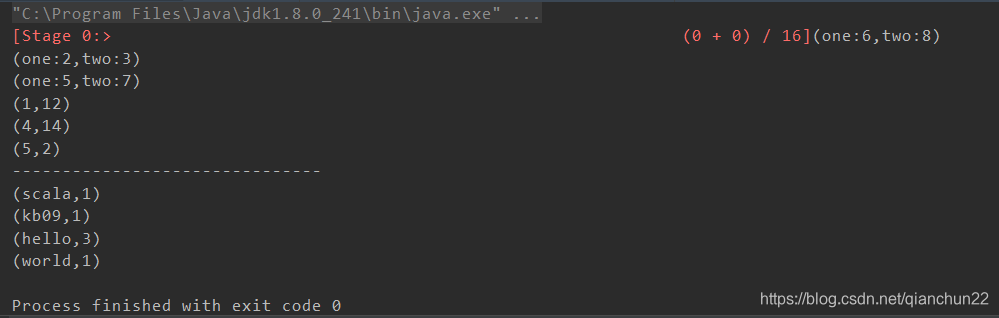
val reduceByKeyRDD = rdd1.reduceByKey((x,y) => {println("one:"+x,"two:"+y);x+y} )
reduceByKeyRDD.collect.foreach(println)

//单词计数
val lines = sc.textFile("in/word.txt")
lines.flatMap(x=>x.split(" ")).map((_,1)).reduceByKey(_+_).collect.foreach(println)
Java版本
public static void main(String[] args) {
    SparkConf conf = new SparkConf().setMaster("local[*]").setAppName("ReduceByKeyJava");
    JavaSparkContext sc = new JavaSparkContext(conf);

    JavaRDD<String> rdd1 = sc.textFile("in/sample.txt");

    PairFlatMapFunction<String, String, Integer> pairFlatMapFunction = new PairFlatMapFunction<String, String, Integer>() {
        @Override
        public Iterator<Tuple2<String, Integer>> call(String s) throws Exception {
            String[] split = s.split(" ");
            ArrayList<Tuple2<String, Integer>> list = new ArrayList<>();
            for (String str :
                    split) {
                Tuple2<String, Integer> tup2 = new Tuple2<String, Integer>(str, 1);
                list.add(tup2);
            }
            return list.iterator();
        }
    };

    Function2<Integer, Integer, Integer> function2 = new Function2<Integer, Integer, Integer>() {
        @Override
        public Integer call(Integer v1, Integer v2) throws Exception {
            return v1 + v2;
        }
    };

    JavaPairRDD<String, Integer> stringIntegerJavaPairRDD =
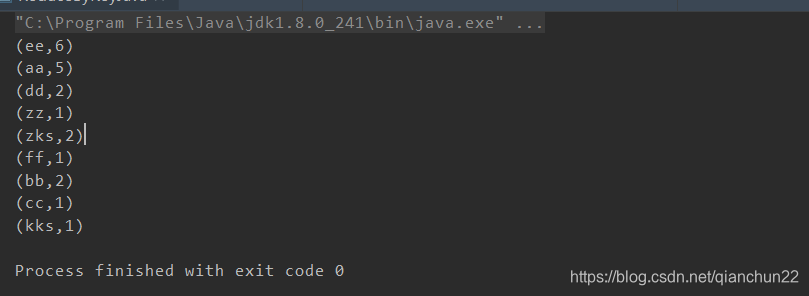
            rdd1.flatMapToPair(pairFlatMapFunction).reduceByKey(function2);

    List<Tuple2<String, Integer>> collect = stringIntegerJavaPairRDD.collect();
    for (Tuple2<String, Integer> tuple2 :
            collect) {
        System.out.println(tuple2);
    }
}
二、foldByKey
def foldByKey(zeroValue: V)(func: (V, V) => V): RDD[(K, V)]
def foldByKey(zeroValue: V, numPartitions: Int)(func: (V, V) => V): RDD[(K, V)]
def foldByKey(zeroValue: V, partitioner: Partitioner)(func: (V, V) => V): RDD[(K, V)]
该函数用于RDD[K,V]根据K将V做折叠、合并处理,其中的参数zeroValue表示先根据映射函数将zeroValue应用于V,进行初始化V,再将映射函数应用于初始化后的V
与reduce不同的是 foldByKey开始折叠的第一个元素不是集合中的第一个元素,而是传入的一个元素
scala版本
object FoldByKeyScala {
  def main(args: Array[String]): Unit = {
    val conf = new SparkConf().setMaster("local[*]").setAppName("foldByKeyScala")
    val sc = new SparkContext(conf)

    val rdd1 = sc.parallelize(List(("A",2),("A",3),("B",5),("B",8)))
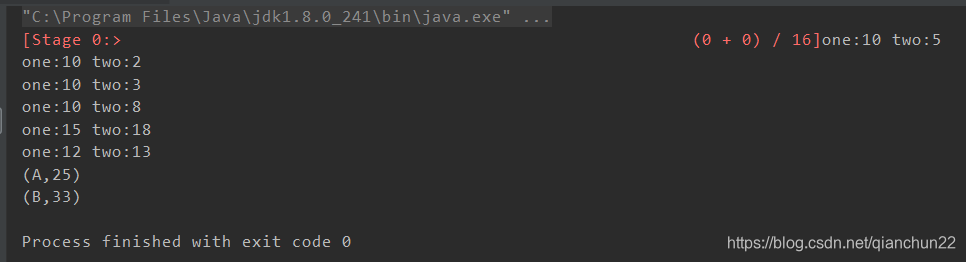
    val foldByKeyRDD = rdd1.foldByKey(10)((x,y)=>{println("one:"+x+" two:"+y);x+y})
    foldByKeyRDD.collect.foreach(println)
  }
}
三、sortByKey
函数定义
def sortByKey(ascending : scala.Boolean = { /* compiled code */ }, numPartitions : scala.Int = { /* compiled code */ }) : org.apache.spark.rdd.RDD[scala.Tuple2[K, V]] = { /* compiled code */ }
SortByKey用于对pairRDD按照key进行排序,第一个参数可以设置true或者false,默认是true
scala版本
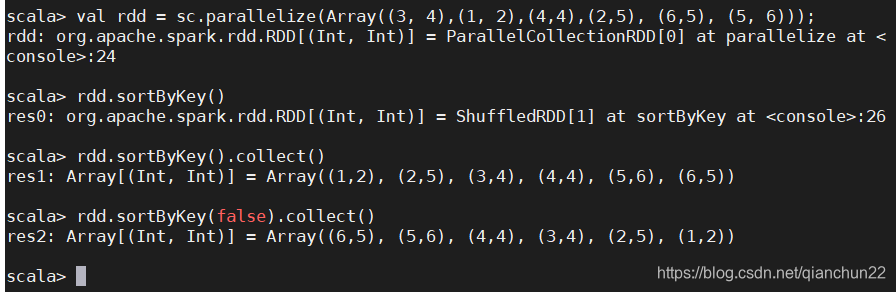
scala> val rdd = sc.parallelize(Array((3, 4),(1, 2),(4,4),(2,5), (6,5), (5, 6)));
rdd: org.apache.spark.rdd.RDD[(Int, Int)] = ParallelCollectionRDD[0] at parallelize at < console>:24

// sortByKey不是Action操作,只能算是转换操作
scala> rdd.sortByKey()
res0: org.apache.spark.rdd.RDD[(Int, Int)] = ShuffledRDD[1] at sortByKey at <console>:26

//看看sortByKey后是什么类型
scala> rdd.sortByKey().collect()
res1: Array[(Int, Int)] = Array((1,2), (2,5), (3,4), (4,4), (5,6), (6,5))

//降序排序
scala> rdd.sortByKey(false).collect()
res2: Array[(Int, Int)] = Array((6,5), (5,6), (4,4), (3,4), (2,5), (1,2))
Java版本
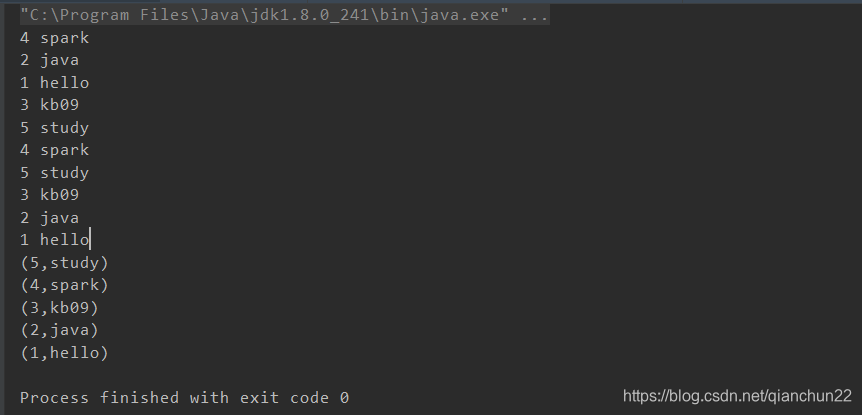
public class SortByKeyJava {
    public static void main(String[] args) {
        SparkConf conf = new SparkConf().setMaster("local[*]").setAppName("sortByKeyJava");
        JavaSparkContext sc = new JavaSparkContext(conf);

        List<Tuple2<Integer, String>> list = new ArrayList<>();
        list.add(new Tuple2<>(5,"study"));
        list.add(new Tuple2<>(2,"java"));
        list.add(new Tuple2<>(4,"spark"));
        list.add(new Tuple2<>(3,"kb09"));
        list.add(new Tuple2<>(1,"hello"));

        JavaRDD<Tuple2<Integer, String>> rdd1 = sc.parallelize(list);

        PairFunction<Tuple2<Integer, String>, Integer, String> pairFunction = new PairFunction<Tuple2<Integer, String>, Integer,  String>() {
            @Override
            public Tuple2<Integer, String> call(Tuple2<Integer, String> tup2) throws Exception {
                System.out.println(tup2._1 + " " + tup2._2);
                return tup2;
            }
        };
        JavaPairRDD<Integer, String> integerStringJavaPairRDD = rdd1.mapToPair(pairFunction);
        // false:降序排序
        JavaPairRDD<Integer, String> sortByKeyRDD = integerStringJavaPairRDD.sortByKey(false);
        List<Tuple2<Integer, String>> collect = sortByKeyRDD.collect();
        for (Tuple2 tup2 :
                collect) {
            System.out.println(tup2);
        }
    }
}

腾讯云面向开发者汇聚海量精品云计算使用和开发经验,营造开放的云计算技术生态圈。
更多推荐
 1
1 0
0- 0


 已为社区贡献4条内容

所有评论(0)