刘二大人《PyTorch深度学习实践》循环神经网络RNN高级篇
个人认为RNN的两个视频讲的没有前面几个视频通俗易懂
任务:输入名字,输出名字对应的国家
模型
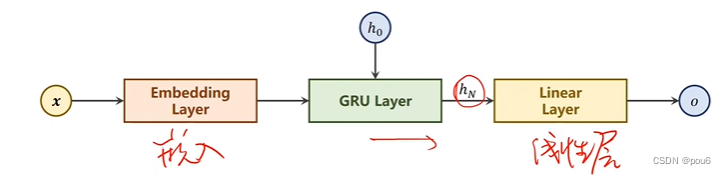
########################################### 题外话 本次使用了双向循环神经网络
Bi-Direction RNN/LSTM/GRU 双向循环神经网络
对于单向的循环神经网络,输出只考虑过去的信息(只有一个方向),而有些情景需要考虑未来的信息
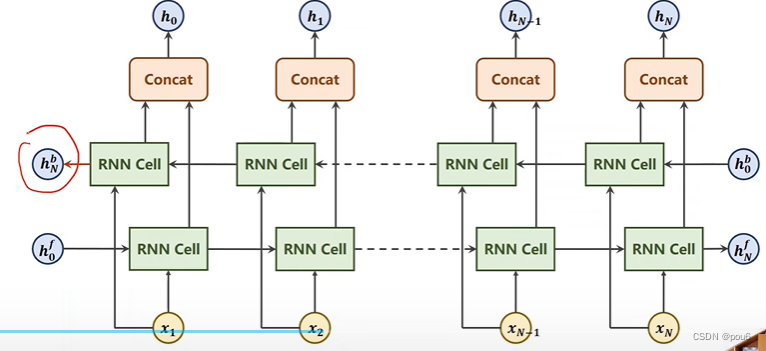
将正向和反向的隐藏层做拼接
###############################################################
着重解释 数据处理部分
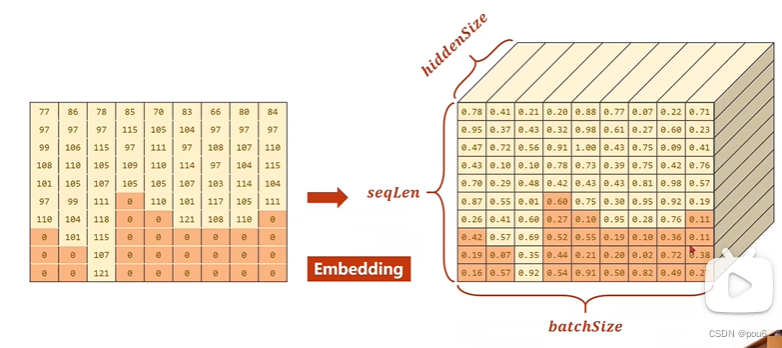
输入单词,先转变成序列,因为都是英文字符所以使用ascll表
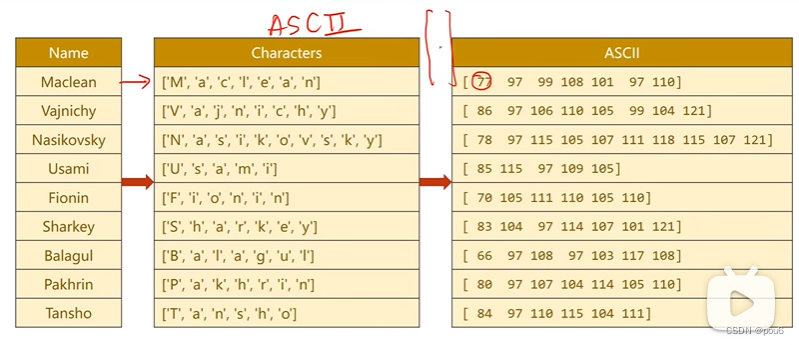
若对于'M'使用独热向量,则77表示只有第77个元素为1(过于稀疏)
对于张量。要求所有的张量维度相等,所以需要padding填充
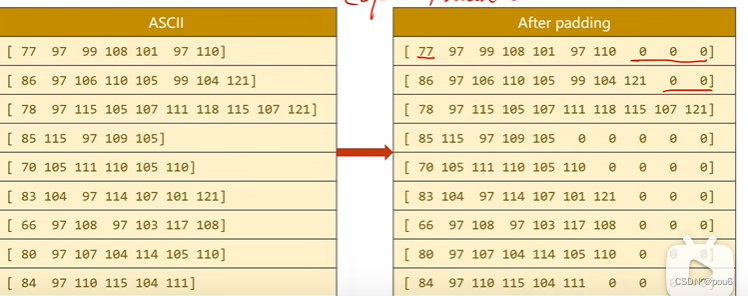
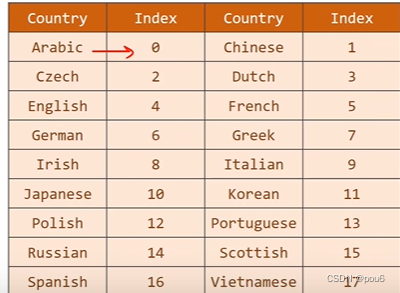
对于国家名,处理成索引标签
对padding后的矩阵转置再经过Embedding
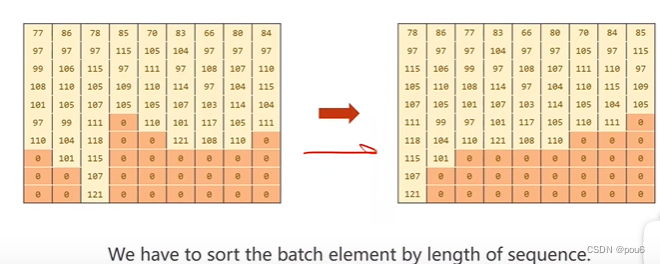
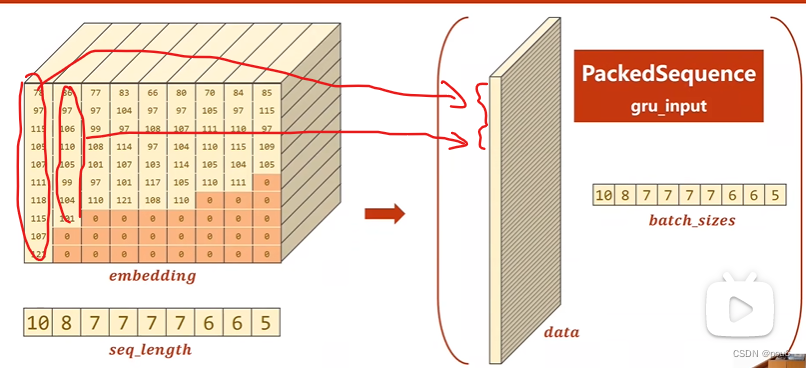
对于变长序列,按序列长度排序后(不排序没法用PackedSequence),通过PackedSequence只存非0的维度,同时记住每个序列的非0项的长度(提高储存密度,提高计算速度),输入gru中
代码实现:
def make_tensors先把名字的ascll和长度、国家取出
然后设置一个全0张量尺寸 (batchsize,seq_lengths.max())
再把数据覆盖上去
然后按序列长度从大到小排序,同时把countries列表也转成相应的从大到小格式
最后输出tensor格式的seq_tensor、seq_lengths、countries
这样在训练时,seq_tensor、seq_lengths会传入模型
使用
gru_input = pack_padded_sequence(embedding,seq_lengths) pack_padded_sequence()将会自动根据序列长度去掉0项
##################################################################
全文代码实现
import torch
import csv
from torch.utils.data import DataLoader,Dataset
from torch.nn.utils.rnn import pack_padded_sequence
import matplotlib.pyplot as plt
# 输入姓名 输出属于哪个国家
import gzip
import time

HIDDEN_SIZE = 100
BATCH_SIZE = 1024
N_LAYER = 2
N_EPOCHS = 100
N_CHARS = 128
USE_GPU = False
start = time.time()

#############################################################################    读入数据
class NameDataset(Dataset):
    def __init__(self,is_train_set=True):
        filename = './names_train.csv' if is_train_set else './names_test.csv'
        with open (filename,'rt') as f:
            reader = csv.reader(f)
            rows = list(reader)
        self.names = [row[0] for row in rows]  #第一列人名
        self.len = len(self.names)  #名字长度
        self.countries = [row[1] for row in rows]   #对应国家名
        self.country_list = list(sorted(set(self.countries))) #对国家名长度排序
        self.country_dict = self.getCountryDict()  #构造字典 key:国家名 value:index
        self.country_num = len(self.country_list)  #国家个数

    def __getitem__(self, index):     #必须重写__getitem__和__len__方法
        return self.names[index],self.country_dict[self.countries[index]]

    def __len__(self):
        return self.len

    def getCountryDict(self):
        country_dict = dict()
        for idx,country_name in enumerate(self.country_list,0):
            country_dict[country_name] = idx
        return country_dict

    def idx2country(self,index):
        return  self.country_list[index]

    def getCountriesNum(self):
        return self.country_num

trainset = NameDataset(is_train_set=True)
trainloader = DataLoader(trainset, batch_size=BATCH_SIZE, shuffle=True)
testset = NameDataset(is_train_set=False)
testloader = DataLoader(testset, batch_size=BATCH_SIZE, shuffle=True)

N_COUNTRY = trainset.getCountriesNum()


##############################################################################      模型

class RNNClassifier(torch.nn.Module):
    def __init__(self,input_size,hidden_size,output_size,n_layers=1,bidirectional=True):
        super(RNNClassifier,self).__init__()
        self.hidden_size = hidden_size
        self.n_layers=n_layers
        self.n_directions = 2 if bidirectional else 1  #单向还是双向循环神经网络
        self.embedding = torch.nn.Embedding(input_size,hidden_size)
        self.gru = torch.nn.GRU(hidden_size,hidden_size,n_layers,bidirectional=bidirectional)
        self.fc = torch.nn.Linear(hidden_size*self.n_directions,output_size) #如果是双向则维度*2
    def _init_hidden(self,batch_size):
        hidden = torch.zeros(self.n_layers*self.n_directions,batch_size,self.hidden_size)
        return create_tensor(hidden)
    def forward(self,input,seq_lengths):
        #input shape Batchsize*SeqLen->SeqLen*Batchsize
        input = input.t()  #矩阵转置
        batch_size = input.size(1)

        hidden = self._init_hidden(batch_size)
        embedding = self.embedding(input)

        # pack them up
        gru_input = pack_padded_sequence(embedding,seq_lengths)  ### make be sorted by descendent  打包变长序列

        output , hidden = self.gru(gru_input,hidden)
        if self.n_directions == 2:
            hidden_cat = torch.cat([hidden[-1],hidden[-2]],dim=1)
        else:
            hidden_cat = hidden[-1]
        fc_output = self.fc(hidden_cat)
        return fc_output


############################################################################   数据处理
def create_tensor(tensor):
    if USE_GPU:
        device = torch.device("cuda:0")
        tensor = tensor.to(device)
    return tensor

def name2list(name):   #返回ascll值和长度
    arr = [ord(c) for c in name]
    return arr, len(arr)

def make_tensors(names,countries):
    sequences_and_lengths = [name2list(name) for name in names]
    name_sequences = [sl[0] for sl in sequences_and_lengths]  #名字的ascll值
    seq_lengths = torch.LongTensor([sl[1] for sl in sequences_and_lengths]) #单独把列表长度拿出来 (名字的长度)
    countries = countries.long()

    #make tensor of name,BatchSize x SeqLen   padding
    seq_tensor = torch.zeros(len(name_sequences),seq_lengths.max()).long()   #先做一个batchsize*max(seq_lengths)全0的张量
    for idx,(seq,seq_len) in enumerate(zip(name_sequences,seq_lengths),0):
        seq_tensor[idx,:seq_len]= torch.LongTensor(seq)   #把数据贴到全0的张量上去

    #sort by length to use pack_padded_sequence
    seq_lengths,perm_idx = seq_lengths.sort(dim=0,descending=True)   #sort返回排完序的序列和对应的index
    seq_tensor = seq_tensor[perm_idx]
    countries = countries[perm_idx]

    return create_tensor(seq_tensor),\
        create_tensor(seq_lengths),\
        create_tensor(countries)

############################################################################     训练测试模块
def trainModel():
    total_loss = 0
    for i,(names,countries) in enumerate(trainloader,1):
        inputs,seq_lengths,target  = make_tensors(names,countries)
        output = classifier(inputs,seq_lengths)
        loss = criterion(output,target)
        optimizer.zero_grad()
        loss.backward()
        optimizer.step()

        total_loss+=loss.item()
        if i%10==0:
            print(f'[{time_since(start)}] Epoch{epoch}',end='')
            print(f'[{i*len(inputs)}/{ len(trainset)}]',end='')
            print(f'loss={total_loss/(i*len(inputs))}')
    return total_loss

def testModel():
    correct = 0
    total = len(testset)
    print("evaluating trained model...")
    with torch.no_grad():
        for i,(names,countrise) in enumerate(testloader,1):
            inputs,seq_lengths,target = make_tensors(names,countrise)
            output = classifier(inputs,seq_lengths)
            pred = output.max(dim = 1,keepdim=True)[1]
            correct+=pred.eq(target.view_as(pred)).sum().item()

        percent = '%.2f'%(100*correct/total)
        print(f'Test set:Accuracy {correct}/{total} {percent}%')

    return correct/total

def time_since(start):
    """
    计算给定时间戳 `start` 与当前时间之间的时间差
    """
    return time.time() - start

if __name__=='__main__':
    classifier = RNNClassifier(N_CHARS, HIDDEN_SIZE, N_COUNTRY, N_LAYER)
    device = torch.device('cuda' if torch.cuda.is_available() else 'cpu')
    if USE_GPU:
        device = torch.device("cuda:0")
        classifier.to(device)

    criterion = torch.nn.CrossEntropyLoss()
    optimizer = torch.optim.Adam(classifier.parameters(), lr=0.001)


    print("Training for %d epochs..." % N_EPOCHS)
    acc_list = []
    epoch_list=[]
    for epoch in range(1,N_EPOCHS+1):
        trainModel()
        acc=testModel()
        acc_list.append(acc)
        epoch_list.append(epoch)
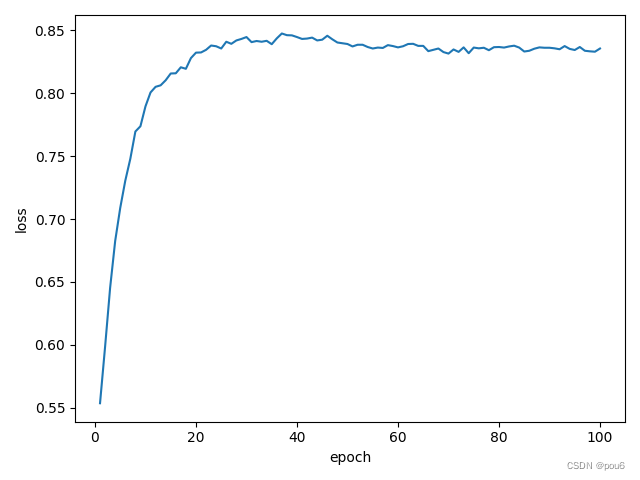
    plt.plot(epoch_list,acc_list)
    plt.ylabel('Accuracy')
    plt.xlabel('epoch')
    plt.grid()
    plt.show()
#################################################################
使用该模型参加kaggle的电影评论分析比赛(第一次在kaggle提交数据)
Sentiment Analysis on Movie Reviews | Kaggle
最终准确率

movie_Submission使用双向循环网络
movie_Submission_2不使用双向循环网络
准确率较差,因为我没有语义分割而是直接把文本变成Ascii码进行训练

腾讯云面向开发者汇聚海量精品云计算使用和开发经验,营造开放的云计算技术生态圈。
更多推荐
 2
2 0
0- 0


 已为社区贡献3条内容

所有评论(0)