信息反馈多目标粒子群优化算法【附代码】
✨ 本团队擅长数据搜集与处理、建模仿真、程序设计、仿真代码、论文写作与指导,毕业论文、期刊论文经验交流。
✅ 专业定制毕设、代码
✅ 成品或定制,查看文章底部微信二维码
(1) 基于互信息反馈与模糊推理的反馈机制设计
为了解决传统反馈模型在多目标环境下的适应性问题,本文首先提出了一种基于互信息反馈模型的多目标粒子群优化算法(MOPSO-MIF)。该方法利用信息论中的互信息概念,量化粒子个体历史最优位置与全局最优位置(或外部档案中的引导粒子)之间的相关性。通过计算粒子间的互信息值,算法能够智能地为每个粒子分配差异化的权重,使得粒子在更新位置时能够更有针对性地借鉴那些与其具有高相关性的优秀个体的历史信息。这种机制不仅保留了种群的进化惯性,还增强了对优秀历史轨迹的继承性。然而,互信息计算涉及复杂的概率密度估计,计算代价较高。为此,本文进一步提出了基于模糊推理反馈模型的改进算法(MOPSO-MEOP)。该算法结合了最大熵原理与模糊逻辑,构建了一个轻量级的模糊推理系统。该系统根据粒子的适应度变化率和多样性贡献等输入变量,利用一步预测策略快速估算反馈模型中的权重参数,从而在保证反馈有效性的同时大幅降低了计算时间,显著提升了算法的实时性。
(2) 引入竞争机制与外部档案更新策略
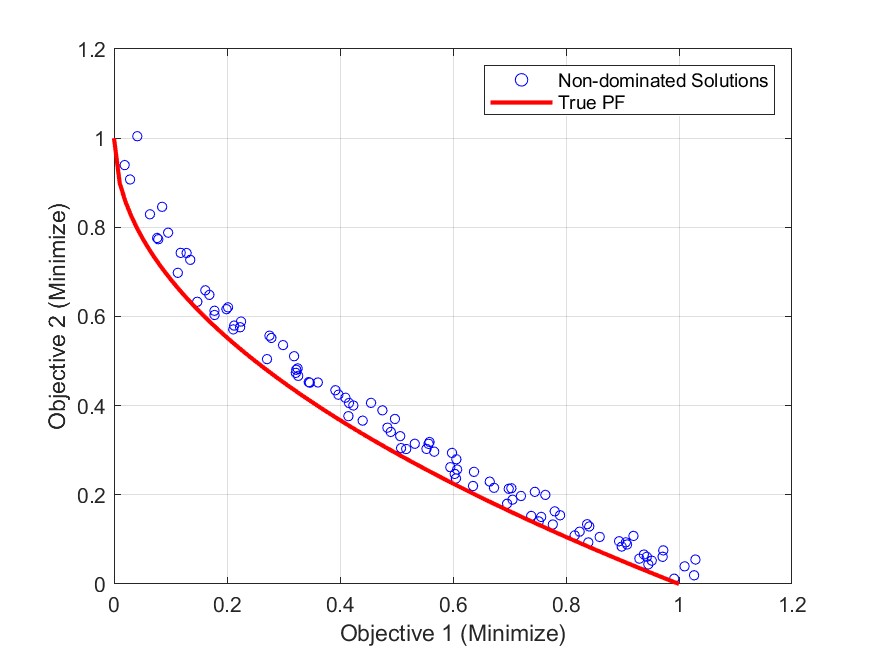
在MOPSO-MEOP算法中,除了引入模糊推理反馈外,本文还借鉴了竞争粒子群优化算法(CSO)的优胜劣汰机制来优化外部档案的维护策略。传统的外部档案往往采用拥挤距离进行维护,容易导致边界解丢失或分布不均。本文提出的策略是对外部档案中的非支配解进行成对竞争,胜利者保留并指导种群更新,失败者则向胜利者学习或进行变异重置。这种机制加速了外部档案中劣质解的淘汰过程,使得引导粒子始终保持较高的质量。同时,竞争机制引入的随机性也在一定程度上增强了算法跳出局部最优的能力,特别是在处理具有多阈值图像分割等实际问题时,该策略能够快速收敛到Pareto前沿,获得高质量的分割阈值组合。
(3) 基于速度反馈的参数自适应调整策略
针对信息反馈模型中参数通常依赖经验选取、难以适应动态优化过程的问题,本文提出了基于速度反馈的多目标粒子群优化算法(V-MOPSO)。速度是粒子群算法中反映搜索状态的关键指标,粒子的飞行速度大小直接关联其探索(Exploration)与开发(Exploitation)能力。V-MOPSO算法利用粒子当前的速度模长作为反馈信号,动态确定反馈模型中的权重系数。在算法迭代初期,粒子速度较大,反馈机制赋予较大的权重以鼓励全局探索,防止早熟收敛;在迭代后期,随着粒子速度减小,权重自适应降低,引导粒子在局部范围内进行精细搜索。这种基于速度的自适应反馈机制无需复杂的外部参数设置,具有极强的鲁棒性。
import numpy as np
import math

class InfoFeedbackMOPSO:
    def __init__(self, objective_funcs, bounds, pop_size=50, max_iter=100):
        self.funcs = objective_funcs
        self.bounds = bounds
        self.dim = len(bounds)
        self.pop_size = pop_size
        self.max_iter = max_iter
        self.positions = np.random.uniform(bounds[0][0], bounds[0][1], (pop_size, self.dim))
        self.velocities = np.zeros((pop_size, self.dim))
        self.pbest = self.positions.copy()
        self.pbest_val = np.array([self.evaluate(p) for p in self.positions])
        self.archive = []

    def evaluate(self, x):
        return [f(x) for f in self.funcs]

    def dominates(self, y1, y2):
        return all(a <= b for a, b in zip(y1, y2)) and any(a < b for a, b in zip(y1, y2))

    def update_archive(self, solution, value):
        is_dominated = False
        for i in range(len(self.archive) - 1, -1, -1):
            if self.dominates(self.archive[i][1], value):
                is_dominated = True
                break
            elif self.dominates(value, self.archive[i][1]):
                self.archive.pop(i)
        if not is_dominated:
            self.archive.append((solution.copy(), value))

    def calculate_mutual_information_weight(self, velocity):
        # Simplified simulation of mutual info weight based on velocity magnitude
        speed = np.linalg.norm(velocity)
        return 1.0 / (1.0 + math.exp(-speed))

    def fuzzy_reasoning_weight(self, iter_ratio):
        # Simplified fuzzy logic simulation
        if iter_ratio < 0.3: return 0.9
        elif iter_ratio < 0.7: return 0.5
        else: return 0.1

    def optimize(self):
        w_max, w_min = 0.9, 0.4
        for t in range(self.max_iter):
            w = w_max - (w_max - w_min) * t / self.max_iter

            # Select global best (gbest) from archive randomly for simplicity
            if not self.archive:
                gbest = self.pbest[np.random.randint(0, self.pop_size)]
            else:
                gbest = self.archive[np.random.randint(0, len(self.archive))][0]

            for i in range(self.pop_size):
                # Velocity Feedback Strategy
                feedback_w = self.calculate_mutual_information_weight(self.velocities[i])

                r1, r2 = np.random.rand(), np.random.rand()
                self.velocities[i] = (w * self.velocities[i] +
                                      feedback_w * r1 * (self.pbest[i] - self.positions[i]) +
                                      2.0 * r2 * (gbest - self.positions[i]))

                self.positions[i] += self.velocities[i]
                self.positions[i] = np.clip(self.positions[i],
                                            [b[0] for b in self.bounds],
                                            [b[1] for b in self.bounds])

                curr_val = self.evaluate(self.positions[i])
                if self.dominates(curr_val, self.pbest_val[i]):
                    self.pbest[i] = self.positions[i].copy()
                    self.pbest_val[i] = curr_val

                self.update_archive(self.positions[i], curr_val)

        return [a[1] for a in self.archive]

def obj1(x): return x[0]**2
def obj2(x): return (x[0]-2)**2

if __name__ == "__main__":
    mopso = InfoFeedbackMOPSO([obj1, obj2], [(-5, 5)]*2)
    pareto_front = mopso.optimize()
    print(len(pareto_front))
成品代码50-200,定制代码300起,可以直接沟通
👇👇👇👇👇👇👇👇👇👇👇👇👇👇👇👇👇👇👇👇👇👇

腾讯云面向开发者汇聚海量精品云计算使用和开发经验,营造开放的云计算技术生态圈。
更多推荐
 4
4 0
0- 0


 已为社区贡献6条内容

所有评论(0)