opencv项目实战——答题卡识别
观察此图发现需要将答题卡透视变换,再提取出所有的圆圈,进行排序,最后判断答案。如下图,要求识别出答题卡的答案,并与正确答案比对(B,E,A,D,B)6、判断哪个选择答案与正确答案(这里采用统计白色像素数量)为了比对正确答案,将正确答案与其索引值相匹配。5、轮廓排序(从上到下、从左到右)7、对比标准答案 、 打分。1、读取图像 、 预处理。2、找到答题卡最大外框。4、提取所有选项圆圈。
·
如下图,要求识别出答题卡的答案,并与正确答案比对(B,E,A,D,B)
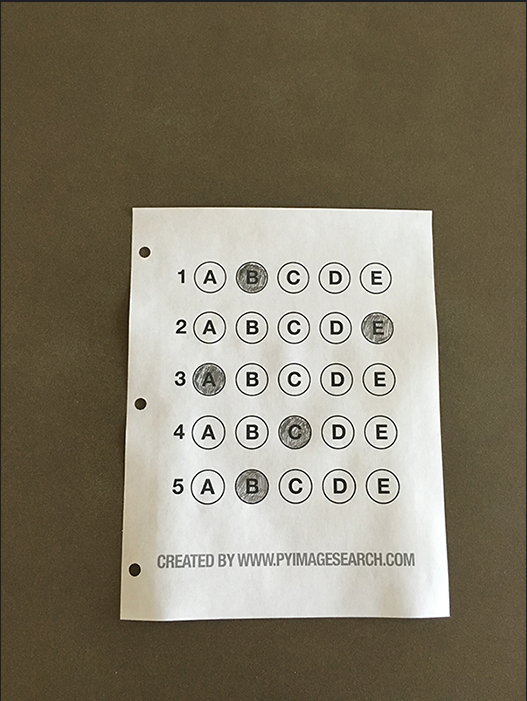
为了比对正确答案,将正确答案与其索引值相匹配
ANSWER_KEY = {0: 1, 1: 4, 2: 0, 3: 3, 4: 1}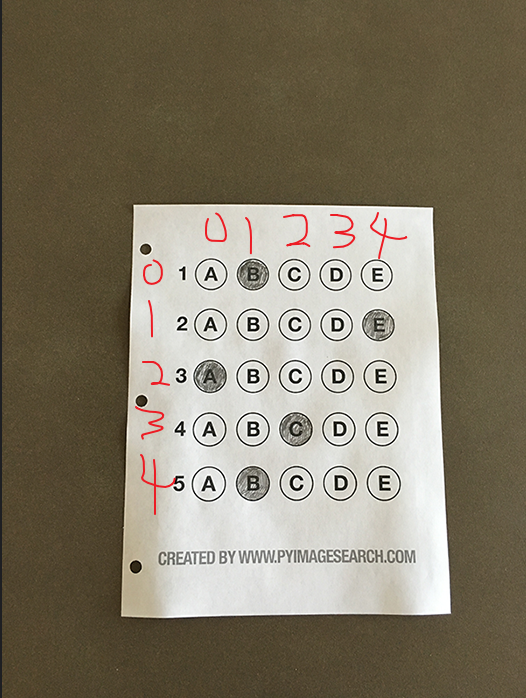
观察此图发现需要将答题卡透视变换,再提取出所有的圆圈,进行排序,最后判断答案。
具体思路流程:
1、读取图像 、 预处理
2、找到答题卡最大外框
3、透视变换
4、提取所有选项圆圈
5、轮廓排序(从上到下、从左到右)
6、判断哪个选择答案与正确答案(这里采用统计白色像素数量)
7、对比标准答案 、 打分
import numpy as np
import cv2

ANSWER_KEY = {0: 1, 1: 4, 2: 0, 3: 3, 4: 1}  # 正确答案

def order_points(pts):
    rect = np.zeros((4, 2), dtype="float32")  # 用来存储排序之后的坐标位置
    # 按顺序找到对应坐标0123分别是左上,右上,右下,左下
    s = pts.sum(axis=1)
    rect[0] = pts[np.argmin(s)]
    rect[2] = pts[np.argmax(s)]
    diff = np.diff(pts, axis=1)
    rect[1] = pts[np.argmin(diff)]
    rect[3] = pts[np.argmax(diff)]
    return rect

def four_point_transform(image, pts):
    # 获取输入的坐标点
    rect = order_points(pts)
    tl, tr, br, bl = rect
    # 计算图像透视变换后的w和h
    widthA = np.sqrt((tr[0] - tl[0]) ** 2 + (tr[1] - tl[1]) ** 2)
    widthB = np.sqrt((br[0] - bl[0]) ** 2 + (br[1] - bl[1]) ** 2)
    maxwidth = max(int(widthA), int(widthB))
    heightA = np.sqrt((tl[0] - bl[0]) ** 2 + (tl[1] - bl[1]) ** 2)
    heightB = np.sqrt((tr[0] - br[0]) ** 2 + (tr[1] - br[1]) ** 2)
    maxheight = max(int(heightA), int(heightB))

    # 变换后对应坐标位置
    dst = np.array([[0, 0], [maxwidth - 1, 0], [maxwidth - 1, maxheight - 1], [0, maxheight - 1]], dtype="float32")

    # 图像透视变换 cv2.getPerspectiveTransform(src,dst[,solveMethod])>MP获得转换之间的关系
    # src:变换前图像四边形顶点坐标
    # dst:变换后图像四边形顶点坐标
    # cv2.warpPerspective(src, MP, dsize[, dst[, flags[, borderMode[, borderValue]]]]) > dst
    # 参数说明:
    # src:原图
    # MP:透视变换矩阵,3行3列
    # dsize:输出图像的大小,二元元组(width,height)
    M = cv2.getPerspectiveTransform(rect, dst)

    warped = cv2.warpPerspective(image, M, (maxwidth, maxheight))
    return warped

def sort_contours(cnts, method="left-to-right"):
    reverse = False
    i = 0

    if method == 'right-to-left' or method == 'bottom-to-top':
        reverse = True
    if method == 'top-to-bottom' or method == 'bottom-to-top':
        i = 1
    boundingBoxes = [cv2.boundingRect(c) for c in cnts]
    (cnts, boundingBoxes) = zip(*sorted(zip(cnts, boundingBoxes),
                                        key=lambda b: b[1][i], reverse=reverse))
    # zip(*...) 使用星号操作符解包排序后的元组列表,并将其重新组合成两个列表:一个包含所有轮廓,另一个包含所有边界框。
    return cnts, boundingBoxes

def cv_show(name, img):
    cv2.imshow(name, img)
    cv2.waitKey(0)

# 预处理
image = cv2.imread('../data/images/test_01.png')
contours_img = image.copy()
gray = cv2.cvtColor(image, cv2.COLOR_BGR2GRAY)
blurred = cv2.GaussianBlur(gray, ksize=(5, 5), sigmaX=0)
cv_show(name='blurred', img=blurred)
edged = cv2.Canny(blurred, threshold1=75, threshold2=200)
cv_show(name='edged', img=edged)

# 轮廓检测
cnts = cv2.findContours(edged.copy(), cv2.RETR_EXTERNAL, cv2.CHAIN_APPROX_SIMPLE)[-2]
cv2.drawContours(contours_img, cnts, -1, color=(0, 0, 255), thickness=3)
cv_show(name='contours_img', img=contours_img)

docCnt = None
# 根据轮廓大小进行排序,准备透视变换
cnts = sorted(cnts, key=cv2.contourArea, reverse=True)
for c in cnts:  # 遍历每一个轮廓
    peri = cv2.arcLength(c, closed=True)
    approx = cv2.approxPolyDP(c, 0.02 * peri, closed=True)  # 轮廓近似
    if len(approx) == 4:
        docCnt = approx
        break

# 执行透视变换
warped_t = four_point_transform(image, docCnt.reshape(4, 2))
warped_new = warped_t.copy()
cv_show(name='warped', img=warped_t)
warped = cv2.cvtColor(warped_t, cv2.COLOR_BGR2GRAY)

# 阈值处理
thresh = cv2.threshold(warped, 0, 255, cv2.THRESH_BINARY_INV | cv2.THRESH_OTSU)[1]
cv_show(name='thresh', img=thresh)
thresh_Contours = thresh.copy()
# 找到每一个圆圈轮廓
cnts = cv2.findContours(thresh, cv2.RETR_EXTERNAL, cv2.CHAIN_APPROX_SIMPLE)[-2]
warped_Contours = cv2.drawContours(warped_t, cnts, -1, color=(0, 255, 0), thickness=1)
cv_show(name='warped_Contours', img=warped_Contours)

questionCnts = []
for c in cnts:  # 遍历轮廓并计算比例和大小
    (x, y, w, h) = cv2.boundingRect(c)
    ar = w / float(h)
    # 根据实际情况指定标准
    if w >= 20 and h >= 20 and 0.9 <= ar <= 1.1:
        questionCnts.append(c)
print(len(questionCnts))

###########################################################
# 按照从上到下进行排序
questionCnts = sort_contours(questionCnts, method="top-to-bottom")[0]

correct = 0
# 每排有5个选项
for (q, i) in enumerate(np.arange(0, len(questionCnts), 5)):
    cnts = sort_contours(questionCnts[i:i + 5])[0]  # 排序
    bubbled = None
    # 遍历每一个结果
    for (j, c) in enumerate(cnts):
        # 使用mask来判断结果
        mask = np.zeros(thresh.shape, dtype="uint8")
        cv2.drawContours(mask, [c], -1, 255, -1)  # -1表示填充
        cv_show(name='mask', img=mask)
        # 通过计算非零点数量来算是否选择这个答案
        # 利用掩膜(mask)进行“与”操作,只保留mask位置中的内容
        thresh_mask_and = cv2.bitwise_and(thresh, thresh, mask=mask)
        cv_show(name='thresh_mask_and', img=thresh_mask_and)
        total = cv2.countNonZero(thresh_mask_and)  # 统计灰度值不为0的像素数
        if bubbled is None or total > bubbled[0]:  # 通过阈值判断,保存灰度值最大的序号
            bubbled = (total, j)
    # 对比正确答案
    color = (0, 0, 255)
    k = ANSWER_KEY[q]

    if k == bubbled[1]:  # 判断正确
        color = (0, 255, 0)
        correct += 1

    cv2.drawContours(warped_new, [cnts[k]], -1, color, thickness=3)  # 绘图
    cv_show('warpeding', warped_new)

score = (correct / 5.0) * 100
print("[INFO] score: {:.2f}%".format(score))
cv2.putText(warped_new, "{:.2f}%".format(score), (10, 30),cv2.FONT_HERSHEY_SIMPLEX, 0.9, (0, 0, 255), 2)

cv2.imshow(winname="Original", mat=image)
cv2.imshow(winname="Exam", mat=warped_new)
cv2.waitKey(0)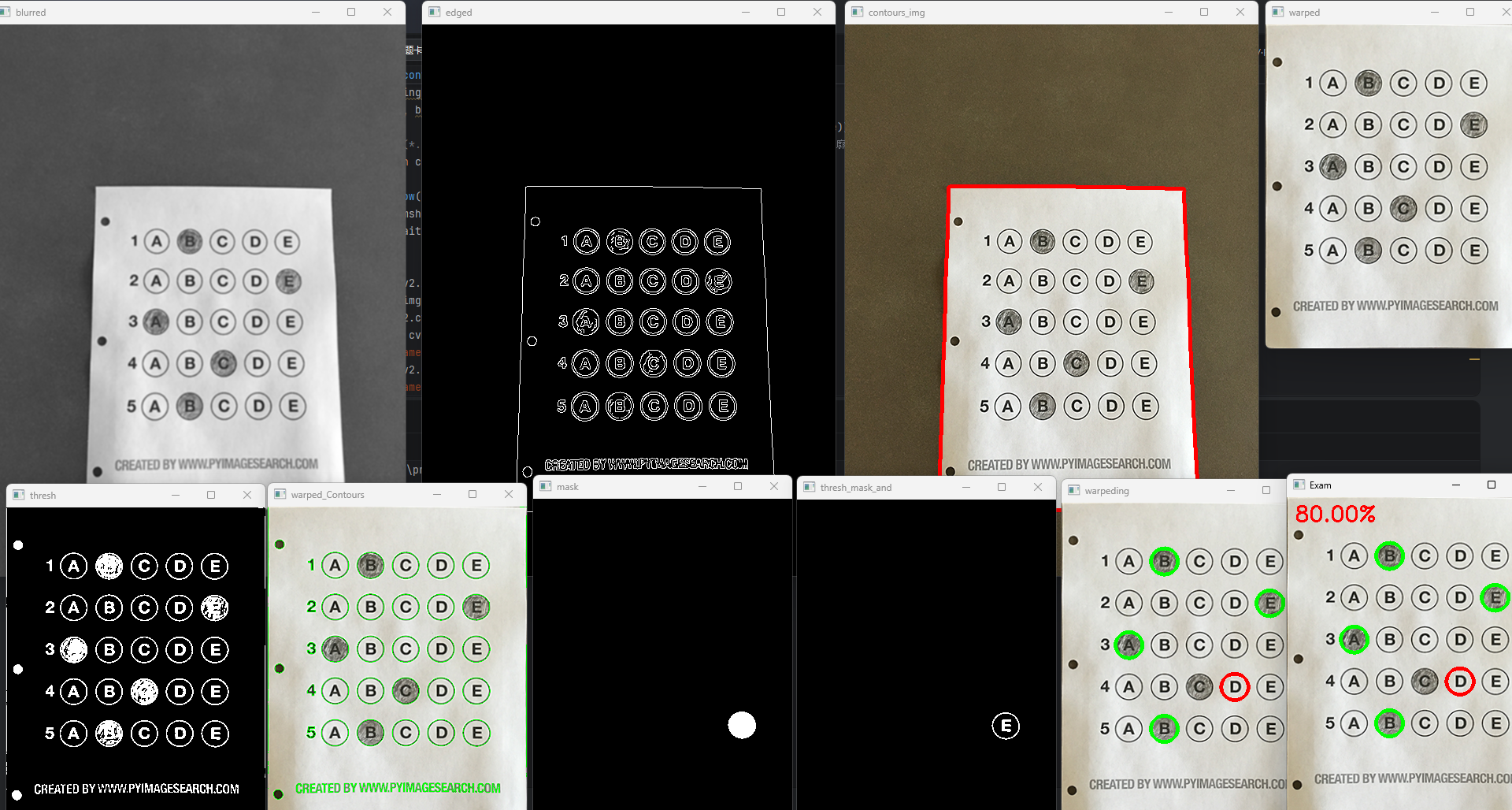

腾讯云面向开发者汇聚海量精品云计算使用和开发经验,营造开放的云计算技术生态圈。
更多推荐
 2
2 0
0- 0


 已为社区贡献13条内容

所有评论(0)